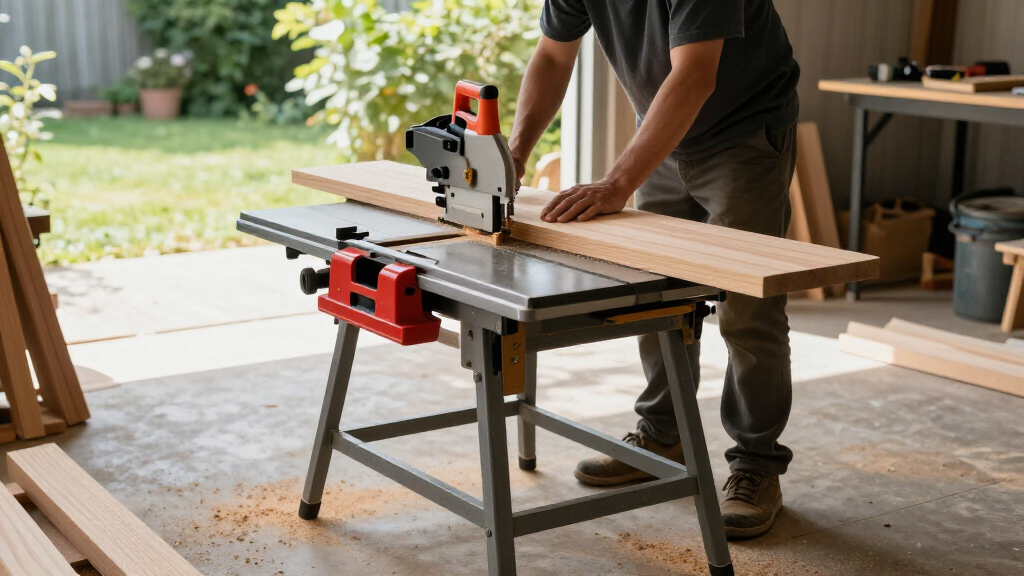
For most woodworkers who need a portable saw with room for sheet goods, the DEWALT DWE7491RS is my best overall pick, while the SKIL TS6307-00 stands out for its folding stand and the DEWALT DWE7485 for compact transport. The main tradeoff is between a larger table and rip capacity, which help with wider work, and a lighter, smaller saw that is easier to move and store. Fence accuracy, stand stability, dust handling, and the work you plan to cut matter as much as motor power. Smaller or lesser-known models may suit occasional projects, but their listed specs alone do not establish the same woodworking capacity or support. Read on for the full comparison and guidance on choosing a saw for your space and projects.

Get business pricing on tools and workshop supplies
- Business-only prices and quantity discounts
- Tax-exempt purchasing
- Multiple users, one account, clear invoices
Complete the kit


Key Takeaways
- The DEWALT DWE7491RS leads for a portable primary saw because its rolling stand and larger jobsite format favor repeated setup and wider work; its size makes it less appealing for tight storage.
- The DEWALT DWE7485 trades table area for easier transport. Its 8-1/4-inch blade and compact format suit smaller shops and mobile work, but buyers should match its cutting capacity to their stock.
- The SKIL TS6307-00 is the stand-focused alternative. Its folding stand helps with storage and transport, though buyers should compare its work support and fence details with the larger DEWALT.
- The Evolution R10TBLX and R10TS separate mobility from simplicity. The wheeled-stand R10TBLX is geared toward rolling between locations; the R10TS is a more straightforward portable option.
- Several listings provide too little detail to rank on woodworking precision alone. For models such as the generic 15-amp saws, Prostormer, and Hoteche, verify fence design, replacement parts, and support before choosing them for repeatable cuts.


| portable table saws for woodworking | Motor | Blade diameter |
|---|---|---|
| DEWALT DWE7491RS 10-Inch Jobsi | 15 amps | 10 inches |
| Evolution R10TBLX 10-Inch Jobs | 15A with soft start | — |
| Evolution R10TS 10-Inch Portab | 15A, soft start | — |
| Hoteche 10-Inch Table Saw with | — | — |
| SKIL 15-Amp 10-Inch Jobsite Ta | 15 amps | 10 inches |
| Prostormer 10-Inch Table Saw w | — | 10 inches |
| 15-Amp Portable 10-Inch Table | 15 amps | 10 inches |
| DOVAMAN 15A Portable Table Saw | 15 amps | — |
| 10-Inch Portable Jobsite Table | 15A pure copper | 10 inches |
| DEWALT DWE7485 15-Amp 8-1/4-In | 15 amps | 8-1/4 inches |
| 10-Inch Table Saw with Stand | 15 amps | — |
| 8-Inch Portable Jobsite Table | 6.7 amps, copper | — |
More Details on Our Top Picks
DEWALT DWE7491RS 10-Inch Jobsite Table Saw with Rolling Stand
The 32-1/2-inch rip capacity gives this DEWALT the clearest advantage for woodworking projects that involve breaking down sheet goods or ripping wide boards. Its rack-and-pinion fence helps keep adjustments quick and controlled, while the rolling stand makes setup and moving the saw around a shop or jobsite less cumbersome. Compared with the SKIL TS6307-00, it offers more rip capacity and a rolling stand, which better suits larger panels and frequent repositioning. The tradeoff is a less compact setup, and the supplied product details do not state its weight. Its 90-degree cut depth is also lower than the Evolution R10TBLX’s listed maximum, so buyers focused on deep cuts should compare those figures carefully. For a portable saw expected to handle varied woodworking stock, this is the most versatile fit in this group.
Pros:- 32-1/2-inch rip capacity accommodates wider panels than the SKIL TS6307-00
- Rack-and-pinion fence supports quick, controlled adjustments
- Rolling stand helps with setup and movement
- Onboard storage keeps included accessories close at hand
Cons:- Rolling stand makes for a larger setup than a compact portable saw
- Product data does not state the saw’s weight
- Listed 90-degree cut depth is shallower than the Evolution R10TBLX’s maximum
Best for: Woodworkers who regularly break down full or wide sheet goods and want a rolling stand for moving the saw between work areas.
Not ideal for: Small-shop woodworkers prioritizing a compact footprint or buyers who need a stated weight before planning transport.
- Model:DWE7491RS
- Blade diameter:10 inches
- Motor:15 amps
- No-load speed:4800 RPM
- Rip capacity:32-1/2 inches
- Cut depth at 90°:3-1/8 inches
- Cut depth at 45°:2-1/4 inches
- Dust port:2-1/2 inches
- Warranty:3-year limited
Our verdict“Choose this DEWALT if wide sheet goods and a mobile stand matter more than keeping the saw compact.”
Evolution R10TBLX 10-Inch Jobsite Table Saw with Wheeled Stand
The R10TBLX suits woodworkers whose projects sometimes move beyond wood: its supplied 10-inch TCT blade is described for cutting wood, mild steel, aluminum, and composites. The soft-start motor and electronic blade brake add jobsite-oriented control, while the wheeled folding stand and onboard storage make the package practical to move and stow. Compared with the DEWALT DWE7491RS, it has less rip capacity at 26 inches, so the DEWALT is the stronger choice for wide sheet goods. The Evolution instead lists a 3-3/8-inch maximum cut depth and includes a dado plate and cross-cut sled, broadening its stated cutting options. Those extras make it a more specialized package, but buyers who mainly rip large panels may get more useful capacity from the DEWALT. The product data does not specify cut depth by blade angle.
Pros:- TCT blade is specified for wood, mild steel, aluminum, and composites
- 26-inch rip capacity with rack-and-pinion fence
- Includes dado plate, zero-clearance throat plate, and cross-cut sled
- Wheeled folding stand and electronic blade brake are included
Cons:- Less rip capacity than the DEWALT DWE7491RS
- Product data gives a maximum cut depth without angle-specific depths
- Multi-material capability may be unnecessary for wood-only shops
Best for: Woodworkers who cut wood alongside mild steel, aluminum, or composites and want a wheeled stand with included cutting accessories.
Not ideal for: Cabinet and furniture makers who frequently rip panels wider than its 26-inch capacity.
- Model:R10TBLX
- Blade size:10 inches
- Motor:15A with soft start
- Rip capacity:26 inches
- Maximum cut depth:3-3/8 inches
- Bevel range:0–45°
- Fence:Rack-and-pinion
- Stand:Collapsible wheeled stand with all-terrain wheels
- Warranty:3 years
Our verdict“Pick the R10TBLX if your woodworking setup also needs stated capability across metal and composite materials.”
Evolution R10TS 10-Inch Portable Jobsite Table Saw
The R10TS pairs a rack-and-pinion fence with a zero-clearance throat plate, dado plate, and cross-cut sled, giving woodworkers several useful setups without sourcing those accessories separately. Its soft-start 15A motor and electronic blade brake, anti-kickback pawls, quick-release riving knife, and large paddle switch make safety and jobsite handling a visible part of the package. Like the R10TBLX, it lists a 26-inch rip capacity, 3-3/8-inch maximum cut depth, and capability with wood, mild steel, aluminum, and composites. The key distinction in the supplied details is that the R10TS emphasizes carry handles and onboard storage, while the R10TBLX specifies a wheeled folding stand. That makes this model easier to carry between nearby work areas, but less convenient to roll when the stand is needed. Its weight is not provided.
Pros:- Includes zero-clearance throat plate, dado plate, and cross-cut sled
- Quick-release riving knife, anti-kickback pawls, and electronic brake are specified
- Carry handles and onboard storage support portable use
- Rack-and-pinion fence and 26-inch rip capacity
Cons:- Supplied details do not list a wheeled stand, unlike the R10TBLX
- Product data does not state the saw’s weight
- 26-inch rip capacity trails the DEWALT DWE7491RS for wide panels
Best for: Woodworkers who carry a saw between nearby work areas and value included sled, dado, and blade-safety features.
Not ideal for: Buyers who need an included wheeled stand for rolling the saw over longer distances or uneven ground.
- Motor:15A, soft start
- Blade:10-inch TCT
- Rip capacity:26 inches
- Maximum cut depth:3-3/8 inches
- Bevel range:0–45°
- Included accessories:Zero-clearance throat plate, dado plate, rack-and-pinion fence, cross-cut sled
- Safety features:Electronic blade brake, anti-kickback pawls, quick-release riving knife, large paddle switch
- Portability features:Carry handles and onboard storage
- Warranty:3 years
Our verdict“Choose the R10TS if you want an accessory-rich saw with specified safety features and can carry it without a wheeled stand.”
Hoteche 10-Inch Table Saw with Stand and Extendable Table
The Hoteche centers its design on extendable side tables, which can give longer or broader stock more support as it approaches and leaves the blade. Its 15-amp motor and listed 5000 RPM no-load speed are paired with a 10-inch, 24-tooth blade, while the 0–45° angle range covers bevel cuts. Compared with the SKIL TS6307-00, Hoteche provides a larger listed main table plus an extension table, but SKIL supplies a folding stand and names features such as parallel blade alignment and an anti-restart switch. The Hoteche product data does not state a rip capacity, weight, or specific safety equipment, making it harder to judge for portable woodworking than the DEWALT DWE7491RS, whose broad rip capacity is explicit. This model makes more sense when added workpiece support is the priority and transport details are less central.
Pros:- Extension table adds support for larger workpieces
- 15-amp motor and 5000 RPM no-load speed are specified
- 0–45° cutting range supports bevel work
- Main and extension table dimensions are provided
Cons:- Product data does not provide a rip capacity
- Weight and portability details are not specified
- Blade guard and riving knife are not listed in the supplied details
Best for: DIY woodworkers who want extension-table support for larger workpieces and can confirm the stand and transport details meet their setup.
Not ideal for: Woodworkers who need a documented rip capacity, known weight, or specified blade-safety equipment before buying.
- Blade:10-inch × 5/8-inch × 24T
- Motor power:15 amps
- No-load speed:5000 RPM
- Cutting angle range:0–45°
- Maximum cut depth at 90°:85 mm
- Maximum cut depth at 45°:65 mm
- Main table size:25.3 × 19.2 inches
- Extension table size:25.3 × 9 inches
Our verdict“Consider the Hoteche when extension-table support matters more than documented rip capacity and transport features.”
SKIL 15-Amp 10-Inch Jobsite Table Saw with Folding Stand (TS6307-00)
The SKIL TS6307-00 is a practical fit for woodworkers who need a folding stand and reliable fence adjustment without the wider panel capacity of the DEWALT DWE7491RS. Its 25.5-inch rip capacity covers many common boards and project panels, while the rack-and-pinion fence rails make it easier to set a consistent cut width. Parallel blade alignment is another useful detail: it helps the blade track with the fence, which matters for controlled ripping. The listed 4×4 cutting capacity at 90° adds flexibility for thicker stock, and a dust port elbow can direct extraction toward a vacuum. Compared with the Evolution R10TS, SKIL highlights folding legs and a dust port elbow, while the Evolution includes a dado plate and cross-cut sled. SKIL’s dado setup requires a separate 8-inch dado blade set and insert.
Pros:- Integrated folding legs support storage and transport
- Rack-and-pinion fence rails aid repeatable width adjustments
- Parallel blade alignment is specified
- Dust port elbow can direct dust toward extraction
Cons:- Rip capacity is less than the DEWALT DWE7491RS
- Dado cuts require a separate 8-inch dado set and dado insert
- Supplied details do not list a rolling stand
Best for: Home and jobsite woodworkers who need a folding-leg saw for storage and mostly cut stock within a 25.5-inch rip capacity.
Not ideal for: Woodworkers who routinely rip extra-wide panels or want dado cutting accessories included in the package.
- Model:TS6307-00
- Power source:Corded electric
- Motor:15 amps
- Voltage:120 volts
- Blade diameter:10 inches
- Rip capacity:25.5 inches
- Bevel capacity:0–45 degrees
- Cutting capacity:Up to 4×4 at 90 degrees
- Dado requirement:8-inch dado blade set with dado insert
Our verdict“Choose the SKIL for folding storage and useful alignment features if its rip capacity covers your typical woodworking stock.”
Prostormer 10-Inch Table Saw with Stand
The Prostormer suits woodworkers who want a full-size blade and basic bevel flexibility in a saw with its own metal supports. Its 1,800-watt motor runs at 5,000 RPM, while adjustable blade height and a 0–45-degree angle cover common crosscuts and bevel work. Compared with the DEWALT DWE7485, it has a larger 10-inch blade, but the DEWALT offers a stated 24.5-inch rip capacity and rack-and-pinion fence for handling sheet goods with more controlled adjustments. The Prostormer’s included blade guard, push stick, and tool storage make setup more self-contained for occasional projects. Its dust port accepts a separately purchased collector, so buyers should plan on a vacuum or expect dust to accumulate. This is a practical general-purpose pick, though its supplied details say less about fence precision and sheet capacity than the DEWALT’s.
Pros:- 10-inch carbide blade supports common woodworking cuts
- Adjustable blade height and 0–45-degree bevel angle
- Blade guard and push stick are included
- Metal supports and onboard tool storage
Cons:- Dust collector is not included
- Rip capacity and fence adjustment details are not specified
Best for: DIY woodworkers who want a 10-inch blade, bevel cuts, and a supported setup for varied home projects
Not ideal for: Woodworkers who regularly rip full sheets and need a clearly specified, precision-adjustable fence
- Power source:Corded electric
- Voltage:120 volts
- Motor power:1,800 watts
- No-load speed:5,000 RPM
- Blade diameter:10 inches
- Blade teeth:24
- Cutting angle:0–45 degrees
- Dust collection:Port for a separately purchased dust collector
Our verdict“Choose the Prostormer for general DIY woodworking with a 10-inch blade and bevel capability, provided you can supply dust collection.”
15-Amp Portable 10-Inch Table Saw with 36-Tooth Blade
At 28.3 pounds, this saw is the easiest option here to move between a small workshop and a job site. Its 15-amp motor reaches 4,600 RPM, and the stated cut depth—up to 3.4 inches at 90 degrees—gives it useful capacity for many boards without the heft of the DEWALT DWE7485. The DEWALT is heavier, but its 24.5-inch rip capacity and rack-and-pinion fence make it the more clearly equipped choice for repeated sheet-goods work. This model instead emphasizes compact portability and material range, with listed support for hardwood, plywood, OSB, thin aluminum, and PVC. A blade guard and vacuum-compatible dust port are included; dust control depends on connecting a vacuum. The supplied details do not state rip capacity, so buyers planning wide panel cuts have less information to work with.
Pros:- Light 28.3-pound body is easier to transport than the 54-pound DEWALT DWE7485
- 10-inch blade and 3.4-inch stated cut depth at 90 degrees
- Listed for hardwood, plywood, OSB, thin aluminum, and PVC
- Blade guard, push rod, and vacuum-compatible dust port included
Cons:- Dust port needs a vacuum for dust collection
- Rip capacity and fence design are not specified
Best for: Woodworkers who need a light 10-inch saw for moving between jobs and cutting boards or smaller panels
Not ideal for: Cabinetmakers and sheet-goods users who need a documented wide rip capacity and precise fence system
- Motor:15 amps
- Blade diameter:10 inches
- Blade teeth:36
- Maximum speed:4,600 RPM
- Weight:28.3 pounds
- Cutting angle:90-degree crosscut; 0–45-degree miter
- Cut depth at 90 degrees:Up to 3.4 inches
- Cut depth at 45 degrees:Up to 2.1 inches
Our verdict“Pick this model when low weight and everyday board-cutting matter more than a documented sheet-goods capacity.”
DOVAMAN 15A Portable Table Saw, 8.5-Inch Dustless with 98% Extraction
The DOVAMAN is the dust-focused choice in this group. It claims 98% dust extraction and pairs that with soft-start technology, which eases startup and can help limit sudden movement in the workpiece. Its expandable surface grows from 48 to 80 cm, giving longer stock more support than the compact working area suggested by the DEWALT DWE7485; the DEWALT, however, lists a 24.5-inch rip capacity for 4×8 sheets. DOVAMAN’s 8.5-inch, 60-tooth blade and 60 mm cut depth at 90 degrees make it better suited to smaller stock and a tidier work area than deep cuts. At 50 pounds, it is less convenient to carry than the 28.3-pound portable 10-inch saw in this roundup, and its dust performance claim should be treated as a stated specification.
Pros:- Stated 98% dust extraction rate
- Soft-start technology is designed to reduce startup vibration
- Expandable work surface extends to 80 cm
- 60-tooth blade and adjustable 0–45-degree bevel
Cons:- At 50 pounds, it is less convenient to carry than the 28.3-pound portable 10-inch saw
- 8.5-inch blade has less stated cutting depth than the 10-inch options
- Corded power requires access to an outlet
Best for: Indoor hobby woodworkers who prioritize a cleaner work area and need an expandable support surface for smaller stock
Not ideal for: Frequent job-site movers or woodworkers who need deep cuts and wide sheet-goods ripping capacity
- Motor:15 amps
- Voltage:120 volts
- Power:1,800 watts
- Speed:5,000 RPM
- Blade size:8.5 inches
- Blade teeth:60
- Cut depth:60 mm at 90 degrees; 40 mm at 45 degrees
- Expandable work surface:48–80 cm wide
- Weight:50 pounds
Our verdict“Choose the DOVAMAN for indoor projects where dust management and extra workpiece support outweigh easy carrying and deeper cuts.”
10-Inch Portable Jobsite Table Saw with Stand, 15A, 5000 RPM
This saw’s clearest advantage is that a stand is included, giving it a ready support setup for a job site or garage. Its 15A motor is listed at 5,000 RPM, and the 60-tooth blade is aimed at smoother cuts in lumber, plywood, and hardwood. The DEWALT DWE7485 is a useful comparison: it uses a smaller 8-1/4-inch blade but specifies a 24.5-inch rip capacity and rack-and-pinion fence, details that matter when sizing sheet goods. This model offers a 10-inch blade and stated 3-11/32-inch maximum cut depth at 90 degrees, but the supplied information does not spell out rip capacity or fence design. Its folding stand helps with storage, though limited setup details leave buyers with less guidance about transport and adjustment.
Pros:- Stand is included and folds for storage
- 10-inch blade with stated 3-11/32-inch maximum cut depth at 90 degrees
- 60-tooth blade is intended for smoother cuts
- 15A motor runs at a listed 5,000 RPM
Cons:- Rip capacity and fence design are not specified
- Stand setup and storage details are limited
Best for: Woodworkers who want a 10-inch saw with a stand included for a garage or semi-permanent job-site setup
Not ideal for: Buyers who need a documented sheet-ripping capacity or detailed fence adjustment system
- Blade diameter:10 inches
- Motor:15A pure copper
- Speed:5,000 RPM
- Blade teeth:60
- Bevel capacity:0–45 degrees
- Maximum cut depth at 90 degrees:3-11/32 inches
- Maximum bevel cut depth:2-9/16 inches
- Included:Stand
Our verdict“Choose this saw if an included stand and 10-inch cutting capacity are your priorities, and confirm its fence and rip capacity suit your projects.”
DEWALT DWE7485 15-Amp 8-1/4-Inch Compact Portable Jobsite Table Saw
The DWE7485 earns its place through a 24.5-inch rip capacity, enough for 4×8 sheet goods, and a rack-and-pinion fence that makes width changes more controlled. That combination favors cabinet parts and plywood breakdown over the deeper cuts available from the 10-inch Prostormer. Its 8-1/4-inch blade keeps the saw compact, while the 5,800-RPM motor and metal roll-cage base suit demanding job-site use. At 54 pounds, though, it is heavier than the 28.3-pound portable 10-inch saw in this roundup, so frequent solo carrying is a less natural fit. The modular guard, riving knife, anti-kickback pawls, and onboard storage add useful setup flexibility. Buyers focused on thicker stock should compare its blade size and cutting depth with the 10-inch alternatives before choosing it.
Pros:- 24.5-inch rip capacity handles 4×8 sheet goods
- Rack-and-pinion fence supports controlled width adjustments
- Metal roll-cage base and onboard accessory storage
- Modular guarding, riving knife, and anti-kickback pawls included
Cons:- 54-pound weight makes frequent carrying less convenient than the 28.3-pound portable 10-inch saw
- 8-1/4-inch blade is smaller than the 10-inch blades on several alternatives
Best for: Woodworkers who regularly break down plywood or OSB and value a precise fence with a compact footprint
Not ideal for: Users who frequently carry a saw alone or need the deeper cuts associated with a 10-inch blade
- Model:DWE7485
- Motor:15 amps
- Blade diameter:8-1/4 inches
- Rip capacity:24.5 inches
- Motor speed:5,800 RPM
- Weight:54 pounds
- Dimensions:22.75 × 22.75 × 13 inches
- Fence:Rack-and-pinion telescoping rails
- Base:Metal roll cage
Our verdict“Choose the DWE7485 for plywood and OSB work where rip capacity and fence control matter more than low carry weight or maximum cut depth.”
10-Inch Table Saw with Stand, 15-Amp Motor, and Protective Cover
The 10-inch blade, 15-amp motor, and 36 × 25-inch tabletop make this a better fit for a home shop that needs room to guide wider work than the compact DEWALT DWE7485. Its listed 5,000 RPM and support for crosscuts and bevels cover common woodworking tasks, while the stand’s rear supports add stability when handling stock. A transparent guard, push stick, and accessory storage give beginners useful safety and setup support, and the dust port can help manage chips when connected to extraction. The tradeoff is that the 74 mm maximum crosscut depth drops to 52 mm for bevel cuts, so thicker material may require another approach. It also lacks the clearly established brand and portability details of the rolling-stand DEWALT DWE7491RS.
Pros:- 10-inch blade and 15-amp motor suit a broad range of woodworking cuts
- 36 × 25-inch tabletop provides workspace for guiding larger pieces
- Stand includes rear supports for added stability
- Includes a transparent blade guard, push stick, protective cover, and dust port
Cons:- Maximum cut depth varies from 74 mm for crosscuts to 52 mm for bevel cuts
- Product data gives limited detail about setup, transport, and stand portability
- Dust port requires a compatible extraction setup to collect dust
Best for: Home woodworkers who want a 10-inch blade, a roomy work surface, and included stand for general cutting and bevel work.
Not ideal for: Woodworkers who regularly move between jobsites or need documented cutting capacity and transport details before choosing a saw.
- Blade size:10 inches
- Motor:15 amps
- Speed:5,000 RPM
- Maximum crosscut depth:74 mm
- Maximum bevel-cut depth:52 mm
- Bevel range:0–45°
- Tabletop size:36 × 25 inches
- Included accessories:Stand, protective cover, transparent blade guard, push stick
Our verdict“Choose this for a stationary home woodworking area that benefits from a full-size blade and roomy tabletop, provided its changing cut-depth limits suit your stock.”
8-Inch Portable Jobsite Table Saw with 6.7-Amp Copper Motor and Sliding Miter Gauge
This saw’s 8-inch blade and 15 × 10-inch footprint make it a more space-conscious choice than the 10-inch DEWALT DWE7491RS, especially for small workshops and occasional DIY projects. Its sliding miter gauge supports 90° crosscuts, and the blade tilts from 0–45° for angled work; those adjustments add versatility for trim and smaller stock. The listed 98.5% dust collection rate and oversized emergency-off switch are useful features for a compact work area. There is a notable portability tradeoff: at 50.3 pounds, it is heavy to carry often, despite the compact dimensions. The data also labels its power source as hand-powered while listing an electric-style motor and RPM, so I would verify the power connection before buying.
Pros:- Compact listed dimensions suit crowded workshops and easier storage
- Sliding miter gauge supports 90° crosscuts, with bevel adjustment from 0–45°
- Listed dust collection rate is 98.5%
- Oversized power switch includes an emergency-off cover
Cons:- At 50.3 pounds, it is heavy for frequent hand carrying
- 8-inch blade is less suited to deeper cuts than the 10-inch DEWALT DWE7491RS
- Power-source listing conflicts with the motor and RPM specifications
Best for: DIY woodworkers with limited bench or storage space who mainly cut smaller stock and value built-in dust collection.
Not ideal for: Woodworkers handling thick or wide boards, or buyers who need a lightweight saw for frequent carrying between jobsites.
- Blade size:8 inches
- Motor:6.7 amps, copper
- Cutting speed:3,576 RPM
- Blade teeth:24
- Bevel angle:0–45°
- Crosscut angle:90°
- Item weight:50.3 pounds
- Dimensions:15 × 10 × 20 inches
- Dust collection rate:98.5%
Our verdict“Consider this compact saw for smaller DIY woodworking jobs if its 8-inch blade and unclear power-source listing fit your needs.”

How We Picked
I compared the 12 saws through the needs of a woodworker who must move, store, and use the tool: cutting capacity, blade size, fence and miter controls, table and stand support, portability, dust handling, and the available product details. A portable saw can have ample motor power on paper yet still frustrate woodworking if its fence is hard to adjust or its support is inadequate for long stock.
The ranking favors models with a clearer fit for regular woodworking and a practical balance of capacity and transport. The DWE7491RS ranks first for its larger jobsite format and rolling stand; the compact DWE7485 and folding-stand SKIL serve different space and mobility needs. Models with sparse specifications rank lower because buyers have less information to judge accuracy, support, and serviceability. I treat advertised features as listing claims, not proof of measured performance.
Factors to Consider When Choosing Portable Table Saws For Woodworking
Before choosing a portable saw, I would start with the work it needs to support and the places it must fit. These factors help separate a capable woodworking station from a saw that is merely easy to carry.
Match blade capacity to your stock
A 10-inch blade is common in this group, while the DEWALT DWE7485 uses an 8-1/4-inch blade. Blade diameter affects cut depth, but it does not tell the whole story: a saw’s stated maximum depth and bevel capacity matter for thicker stock and angled cuts. Think about the actual thicknesses you cut, including whether you expect to resaw or bevel them. A portable table saw is not a bandsaw, and repeated deep cuts can strain both the tool and the workpiece. Check the manufacturer’s capacity figures before buying, especially when a listing gives only motor amperage and blade size. Choosing around your regular stock helps avoid paying for a larger setup you rarely use or finding a compact saw cannot handle a planned cut.
Treat the fence as a woodworking control
For repeatable woodworking, a fence that locks parallel to the blade matters more than a high no-load RPM figure. Look for a clear adjustment method, readable scale, and a firm lock at both ends; the listing should explain how the fence is secured. A narrow or flimsy fence can make ripping long boards harder to control and can undermine consistent dimensions. When details are missing, seek the manual or manufacturer specifications before relying on the saw for cabinet parts or joinery stock. Avoid assuming that a 15-amp motor signals accurate cuts. Budget time for checking fence alignment and blade squareness after transport, since bumps can alter setup even on a capable saw.
Plan for the full footprint, not just the saw
Portable describes movement, but the stand and workpiece support determine how practical a saw is at the jobsite. A rolling stand can save lifting effort across a garage or driveway, while a folding stand may store more neatly in a crowded shop. Either way, account for the opened footprint and room to feed long boards safely. A compact saw can be easier to store yet need extra roller stands or a helper for sheet goods. Check whether the stand is included and how it folds; product names and photos do not always answer those questions clearly. If you work alone, prioritize stable support and controlled setup over the smallest packed size.
Decide how much dust control your workspace needs
Dust collection varies widely between portable saws, and a claim such as dustless operation or a high extraction percentage should be checked against the actual collection arrangement. A saw used indoors needs a compatible shop vacuum or extractor, a practical port connection, and a way to manage dust escaping above the table. Outdoor cutting reduces cleanup in the room but does not eliminate airborne dust exposure. Consider where the saw will run and whether the collection gear can move with it. A compact saw with better-contained dust may suit a small garage better than a higher-capacity model that leaves chips around the workspace. Keep respiratory protection and local dust control in the plan rather than treating a collection claim as a substitute.
Check serviceability before buying a little-known model
Woodworking puts wear on blades, throat plates, fences, switches, and stands, so replacement support matters over the life of a saw. For lesser-known or generically named models, check whether the manual, warranty terms, and replacement parts are easy to locate. Confirm that the arbor accepts common blades and that the saw has the safety equipment you expect, such as a riving knife and blade guard. A low-detail listing makes it harder to compare these points, even when it advertises a strong motor or included stand. If the saw will be used for occasional rough cuts, that uncertainty may be an acceptable tradeoff. For a primary woodworking tool, clearer documentation and service access can be worth choosing over a longer feature list.
Frequently Asked Questions
Is a portable table saw accurate enough for furniture or cabinet work?
It can be, provided the fence locks consistently, the blade is aligned, and the table supports the work without flexing. Portable saws are more sensitive to setup changes after transport, so check blade-to-miter-slot alignment and fence parallelism when you move the saw. For wide panels or long boards, add stable outfeed support so the work does not tip or pull away from the fence. If tight tolerances are central to your projects, compare adjustment features and manuals rather than choosing by motor rating. A stationary cabinet saw may still be a better fit for a permanent shop and heavy daily production.
Should I choose a 10-inch saw or the compact 8-1/4-inch DEWALT?
Choose based on the stock and cut depth you regularly need, not blade size alone. The 10-inch models in this roundup generally offer a familiar capacity for general shop work, while the DWE7485 is more compact for transport and storage. Review each saw’s published maximum depth at 90 and 45 degrees, then compare those figures with your project material. If you often cut thicker stock or need more room around larger workpieces, the compact format may become limiting. For smaller projects and mobile setups, easier storage can matter more than capacity you seldom use.
Can I use a portable table saw in a small garage?
Yes, but measure the space with the stand fully open and include room to feed stock in and out. A folding model can simplify storage, while a wheeled stand may be easier to move out of the way between sessions. Plan for dust collection, safe clearance, and a stable outfeed surface before you set up. Long boards may need more floor space than the saw itself suggests. If you cannot maintain a clear feed path, break down sheet goods with another tool before making final cuts on the table saw.
What should I verify when a product listing gives few woodworking details?
Look for the manual and confirm fence adjustment, rip capacity, bevel range, cut depth, safety equipment, and stand inclusion. Check whether replacement blades and wear parts use common sizes and whether the manufacturer provides support information. A listed 15-amp motor or 5,000 RPM figure cannot tell you whether the fence is rigid or the table adequately supports stock. If the seller cannot clarify core specifications, treat the saw as a less predictable choice for precision work. That may be acceptable for occasional rough cutting, but a primary shop saw deserves clearer documentation.
Is a wheeled stand worth choosing over a folding stand?
A wheeled stand helps when you regularly move the saw across a jobsite or between storage and a work area, especially if lifting is inconvenient. A folding stand may be simpler to store in a narrow garage or vehicle, depending on its folded dimensions and weight. Compare the complete setup, including how quickly the legs deploy and whether the saw feels stable during feeding. Neither stand type removes the need for level placement and outfeed support. Choose around your usual route and storage space rather than assuming wheels always make a saw more portable.
Conclusion
For a portable saw that can serve as a regular woodworking station, I would choose the DEWALT DWE7491RS as best overall, particularly when its rolling stand and larger format suit the workspace. The SKIL TS6307-00 is my value-oriented pick for buyers who want a folding stand, while the DEWALT DWE7485 makes more sense when compact transport and storage take priority. Beginners should favor a model with clear setup instructions, a dependable fence, and an included stable stand; the SKIL or DWE7491RS are easier starting points than an under-documented generic listing. For frequent movement between locations, compare the wheeled Evolution R10TBLX with the DEWALT rolling setup. If dust control or occasional light work is the main need, investigate the DOVAMAN or smaller listings carefully and verify their specifications and support before deciding.
Fall yard work Picks
leaf blowers
As an affiliate, we earn on qualifying purchases.