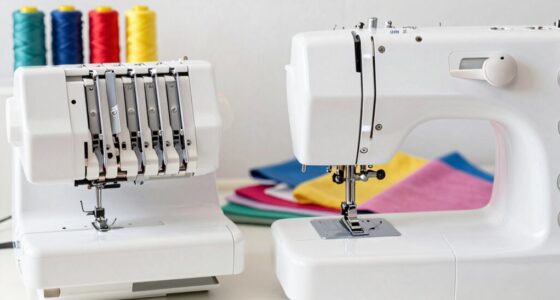
To decide between a 4-thread and a 5-thread serger, consider your fabric types and project needs. If you’re working with lightweight fabrics and want faster sewing, a 4-thread serger offers flexibility and speed. For heavier materials or projects needing extra seam strength, a 5-thread serger is more durable and secure. Think about whether speed or seam durability matters most—this choice can make a big difference. Keep exploring to find the best fit for your sewing style.

Get business pricing on tools and workshop supplies
- Business-only prices and quantity discounts
- Tax-exempt purchasing
- Multiple users, one account, clear invoices
Key Takeaways
- Choose a 4-thread serger for lightweight fabrics and faster sewing projects prioritizing flexibility.
- Opt for a 5-thread serger when seam durability and strength are crucial, especially for heavy or activewear.
- Consider project type: delicate garments suit 4-thread, while heavy-duty items benefit from 5-thread.
- Evaluate long-term costs: 5-thread sergers often require more maintenance but provide stronger, longer-lasting seams.
- Balance your workflow needs: faster sewing favors 4-thread, whereas seam robustness favors 5-thread options.

Choosing the right serger can profoundly impact your sewing projects, and understanding the difference between a 4-thread and a 5-thread serger is vital. Your decision will influence the quality of your seams, the durability of your stitches, and the overall efficiency of your work. When comparing these two types, consider how thread durability and sewing speed play essential roles in your projects. A 4-thread serger typically offers a lighter, more flexible stitch suitable for delicate fabrics and finishing raw edges. It often provides faster sewing speeds because it has fewer threads, which can make your workflow smoother and more efficient. This increased speed allows you to work quickly on projects that don’t demand the extra strength or durability that a 5-thread serger offers. However, with fewer threads, the stitch strength and thread durability might be slightly compromised, especially when sewing heavier or thicker fabrics.
On the other hand, a 5-thread serger introduces an extra loop of thread, creating a more secure and robust seam. This additional thread provides enhanced thread durability, making it ideal for garments that need to withstand frequent washing and wear. The extra thread also improves seam strength and prevents unraveling, which is vital for heavy-duty projects or items like activewear and upholstery. While a 5-thread serger might be slightly slower than its 4-thread counterpart because of the added complexity, the difference in sewing speed isn’t usually significant enough to impact your workflow dramatically. Instead, you’ll notice the benefit of more durable, long-lasting seams that hold up over time, saving you time and effort in repairs or re-stitching. Additionally, understanding fabrics and textiles can help you choose the most appropriate serger for your specific projects. Moreover, considering the thread quality can further enhance the longevity and appearance of your finished pieces. A serger’s threading system also plays a role in how easily you can switch between different stitch types and configurations, impacting your overall efficiency.
Furthermore, it’s beneficial to evaluate the cost and maintenance involved with each serger, as this can influence your long-term satisfaction and budget. To make an informed decision, it’s also helpful to evaluate your typical projects and how much you prioritize seam strength versus sewing speed. Ultimately, your choice depends on what you value most in your sewing projects. If you’re working with lightweight fabrics and prioritize speed, a 4-thread serger might be the better option. But if your focus is on creating sturdy, professional-quality seams that endure wear and washing, a 5-thread serger is worth the investment. Both options offer excellent stitch quality, but the key difference lies in thread durability and sewing speed, which directly influence the performance and longevity of your finished projects. By understanding these factors, you can select the serger that aligns best with your sewing needs, ensuring your projects are both beautiful and durable.
As an affiliate, we earn on qualifying purchases.
Frequently Asked Questions
Can I Convert a 4-Thread Serger to a 5-Thread?
You can’t convert a 4-thread serger to a 5-thread easily, as it requires specific threading configurations and sometimes additional parts. For thread conversion, you’d need to adjust the threading path and possibly add a thread guide or tensioner. This process enhances serger versatility, allowing you to create different seam finishes. However, it’s best to consult your machine’s manual or a professional to guarantee proper conversion without damaging your serger.
Which Serger Type Is Better for Beginner Sewists?
A 4-thread serger is better for beginner sewists because it offers simpler threading, reducing frustration and time spent setting up. It provides solid stitch versatility for basic projects like seams and finishes. Since you’re starting out, this straightforward option helps you learn essential techniques without overwhelming complexity. Once you gain experience, you can explore more advanced features of 5-thread sergers, but the 4-thread model is ideal for building confidence early on.
Do 5-Thread Sergers Cost Significantly More Than 4-Thread Models?
You’ll find that 5-thread sergers typically cost more than 4-thread models, thanks to their added capabilities. Ironically, that extra dollar might be for a fancy thread configuration, but it’s not always necessary unless you need the enhanced seam strength or decorative stitches. The cost comparison mainly reflects the machine’s features rather than just the number of threads, so weigh your sewing needs before splurging.
Are There Specific Fabrics Better Suited for 4-Thread or 5-Thread Sergers?
You should use a 4-thread serger for lightweight fabrics like chiffon or silk, as they require gentle stitching and fabric compatibility. A 5-thread serger provides stronger stitch strength, making it ideal for heavier fabrics such as denim or upholstery. The extra thread offers durability and secure seams, so choose based on your fabric’s weight and the stitch strength needed for your project.
How Does Thread Tension Differ Between 4 and 5-Thread Sergers?
Like a skilled conductor, you’ll find that thread tension differs between 4 and 5-thread sergers. With a 4-thread machine, tension adjustments focus on balancing the looper and needle threads for thread consistency, while a 5-thread serger adds an extra layer, requiring fine-tuning to maintain even stitches. You’ll need to tweak tension settings more precisely in a 5-thread machine to make certain smooth, professional seams every time.
Conclusion
Choosing between a 4-thread and 5-thread serger depends on your sewing needs. If you want a versatile machine for most projects, a 4-thread might be enough. But if you often work with heavy fabrics or need extra durability, a 5-thread offers stronger seams. Did you know that 78% of professional seamstresses prefer a 5-thread serger for their durability? Consider your projects carefully, and pick the machine that’ll give you the best results every time.
Fall yard work Picks
leaf blowers
As an affiliate, we earn on qualifying purchases.