TL;DR

Get business pricing on tools and workshop supplies
- Business-only prices and quantity discounts
- Tax-exempt purchasing
- Multiple users, one account, clear invoices
A Hunker report describes using a handheld angle grinder as an alternative to a stationary bench grinder for sharpening a lawn mower blade. It recommends removing and securing the blade, preserving its existing cutting angle, and using eye, hearing and hand protection.
Hunker has outlined a handheld angle grinder as an alternative to a stationary bench grinder for sharpening lawn mower blades, describing a method that involves removing and securing the blade before grinding. The guidance matters to homeowners who want to maintain a mower without a bench-mounted tool, but it also stresses precautions because angle grinders are powerful, fast-moving tools.
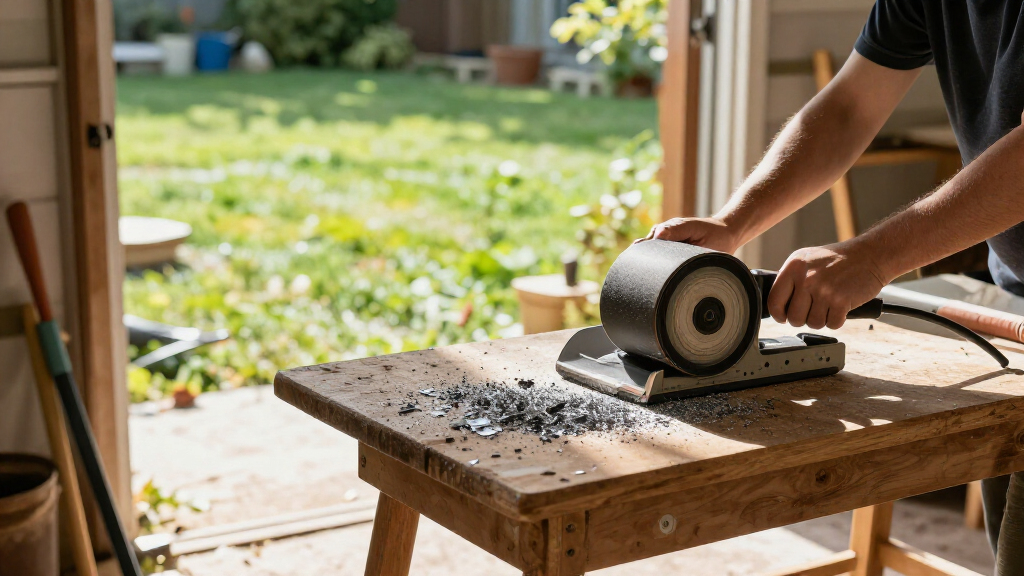
The report describes a 4.5-inch abrasive wheel on an angle grinder, whose wheel sits at a right angle to the tool’s handle. It also references a $99 Makita paddle-switch model listed on Amazon at the time of the report. That price is a source-specific listing, not a current price guarantee, and the article does not establish that this particular model is necessary for the task.
Before sharpening, the blade should be removed from the mower. For a gas-powered mower, the report says to disconnect the spark-plug wire before loosening the blade. It advises cleaning away accumulated dirt and corrosion, then clamping the blade in a vise so it cannot move during grinding.
The grinding wheel should follow the existing cutting edge, with the goal of removing as little metal as possible. Hunker says mower blade edges are usually ground at an angle of about 25 to 35 degrees to the flat of the blade. It recommends light, smooth passes rather than aggressive grinding. The report does not provide a model-specific blade specification, so the blade’s existing geometry remains the reference in its instructions.
A Handheld Tool for Blade Maintenance
The alternative could be useful to people who do not own a stationary bench grinder and already have access to an angle grinder. The process relies on common workshop steps—removing, cleaning and clamping the blade—rather than sharpening it while attached to the mower. This also makes the condition and handling of the blade easier to inspect during the work.
However, convenience does not remove the risks. An angle grinder can take material off quickly, and a blade that is poorly secured or ground unevenly may be damaged or unbalanced. The report’s emphasis on secure clamping, light passes and protective equipment is central to the method, not an optional add-on. It does not compare sharpening results, time or cost against a bench grinder or professional service.
Popular right now

Samsung 42-Inch Class OLED S90F 4K Smart TV (2025)

Philips 5500 Series Fully Automatic Espresso Machine with LatteGo

Dyson V8 Cordless Vacuum
As an affiliate, we earn on qualifying purchases.
How the Suggested Method Works
The article frames the angle grinder as a handheld alternative for sharpening, rather than a new type of mower or blade. Its instructions focus on reproducing the blade’s cutting edge, not changing the blade’s design. The suggested angle of 25 to 35 degrees is presented as a usual range; the source advises retaining the angle already on the blade.
Hunker also notes that angle grinders can sharpen other garden tools, including shovels, axes and mattocks. That broader observation does not change the precautions for mower blades: the tool being sharpened must be secured, and the grinder must be handled with suitable protection. The supplied report includes a purchase-link disclosure, saying the publisher may receive a commission from purchases made through links.
“The goal is to remove as little metal from the edge as possible as you recreate the existing cutting edge.”
— Hunker report
Blade Details and Current Pricing
The supplied source does not identify a publication date, provide current retailer availability, or confirm whether the cited $99 price still applies. It also does not give sharpening instructions for every mower type or blade design, nor does it report controlled tests comparing an angle grinder with a bench grinder.
The guidance says to preserve the blade’s existing edge angle but does not explain how to assess balance after sharpening or specify when a blade is too damaged to reuse. Readers should check the mower and blade manufacturer’s instructions for model-specific requirements. The article’s method should not be treated as proof that every blade can safely be sharpened in the same way.
Check the Blade Before Reuse
Anyone following the method should first consult the mower’s instructions and confirm the blade can be removed and sharpened. Before working, keep the mower’s power source disabled: for a gas mower, disconnect the spark-plug wire as the report advises; for other mower types, follow the manufacturer’s shutdown and isolation instructions. Wear safety goggles, hearing protection and gloves, secure the blade firmly, keep loose clothing and hair away from the wheel, and keep the power cord clear of the grinding area.
After sharpening, inspect the blade for damage and follow the mower maker’s directions for checking and reinstalling it. The source does not set out a balancing procedure or a next publication update, so those points remain outside its guidance. If the blade cannot be secured or the work feels unsafe, stop and seek help from a qualified repair professional.
Key Questions
Can an angle grinder sharpen a lawn mower blade?
Hunker describes a handheld angle grinder as an alternative to a bench grinder. Its method calls for removing and clamping the blade, then using controlled passes along the existing edge.
What angle should the blade edge have?
The report gives a usual range of 25 to 35 degrees to the flat of the blade and says to retain the existing cutting angle. Check the mower or blade maker’s instructions for the specific model.
What safety gear does the report recommend?
It calls for eye protection, hearing protection and gloves. It also advises securing the blade, keeping hair and loose clothing away from the wheel, using good lighting and keeping the power cord clear.
Should the blade be removed before sharpening?
Yes. Hunker’s method says to remove the blade first and clamp it in a vise. For a gas-powered mower, it says to disconnect the spark-plug wire before loosening the blade.
Is the cited Makita grinder still $99?
The report cited a $99 listing, but the supplied source does not give a publication date or confirm current pricing or availability. Check the retailer for current details.
Source: hunker.com