
TL;DR

Get business pricing on tools and workshop supplies
- Business-only prices and quantity discounts
- Tax-exempt purchasing
- Multiple users, one account, clear invoices
A Hunker report describes an Instagram creator’s DIY table runner made by sewing thrifted vintage handkerchiefs together. The project offers a way to reuse small fabric pieces, but the finished runner’s durability and washing needs depend on the condition and materials of the handkerchiefs.
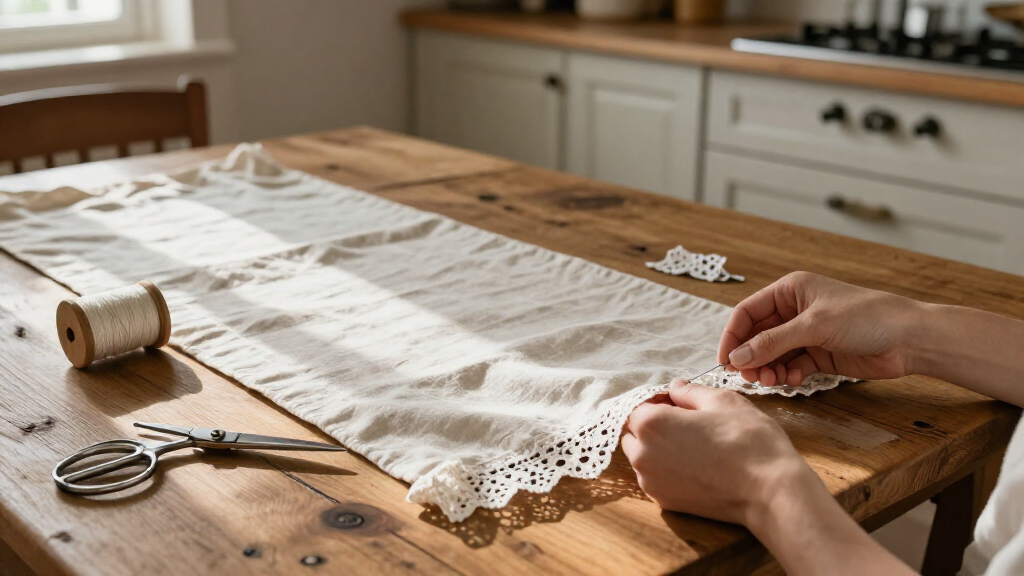
Vintage handkerchiefs can be repurposed as a table runner by sewing the pieces together, according to a DIY project highlighted by Hunker. The report describes Instagram creator Chickie Wu joining thrifted handkerchiefs into a decorative centerpiece, offering an alternative to buying a new runner while leaving the fabric selection and final look open to customization.
Wu’s project uses an assortment of handkerchiefs sourced from a local thrift store. The pieces are lined up end to end and joined with a seam, with the report recommending a simple invisible seam stitch. Because the runner is made from individual cloth squares or rectangles, its length can be adjusted by adding or removing pieces.
Hunker advises checking that vintage fabric is in condition to be sewn and can withstand washing. It recommends measuring the table or other surface before shopping to estimate how many handkerchiefs will be needed. If the pieces vary in size, a maker can keep the uneven edges for a mixed look or hem larger handkerchiefs to create a more consistent outline.
The report also suggests washing the handkerchiefs before sewing, using cold water and hand washing as a cautious approach for older textiles. It recommends a phosphate-free detergent and a sharp needle, since a dull needle could damage delicate fabric. These are general project suggestions; the article does not identify the exact fiber content or care instructions for Wu’s particular handkerchiefs.
A Small-Scale Way to Reuse Fabric
The project shows one way to give vintage textiles a new household use rather than leaving them stored away or discarding them. For readers who already have handkerchiefs, or can find them secondhand, the approach may also avoid the cost of purchasing a finished table runner. The source does not provide a price comparison or quantify any environmental benefit.
Its practical appeal is that the design can change with the materials available: coordinated patterns can create a more unified runner, while varied colors and sizes produce a deliberately mismatched effect. The project is still dependent on having cloth that can tolerate stitching and regular handling. A decorative result is not a guarantee of long-term durability, particularly when the fabric is old or fragile.
As an affiliate, we earn on qualifying purchases.
From Handkerchiefs to Table Decor
Table runners are a smaller alternative to covering an entire dining table with a tablecloth and can be used with placemats, according to Hunker. The report presents the handkerchief project as a customizable home-decor idea, rather than a new product announcement or a professionally tested sewing pattern.
Hunker notes that a maker may look for handkerchiefs at local thrift shops or on Etsy, where sellers sometimes offer collections in related patterns. It also suggests combining vintage and contemporary fabric, including contrasting styles such as lace and paisley. Those possibilities are design suggestions in the report, not evidence that every fabric combination or sewing method will work equally well.
“Who says a lace handkerchief and a paisley bandana can’t work together?”
— Hunker, on combining fabrics
Fabric Condition Shapes the Result
The report does not specify the handkerchiefs’ materials, age, or condition, or provide a detailed image-based assessment of Wu’s finished runner. It is also unclear how the creator finished the outer edges, what seam allowance she used, or whether the finished piece was tested through repeated washing.
Those details matter because vintage textiles can differ widely in strength and care requirements. The suggested cold hand wash is a cautious general approach, not a substitute for checking the fabric and any available care information. Readers should not assume that every thrifted handkerchief is suitable for sewing or can safely be machine washed.
Measure and Check Before Sewing
The next step for anyone trying the project is to measure the intended surface, then source enough handkerchiefs in usable condition. Before joining the pieces, inspect their fabric and seams, wash them gently if appropriate, and let them dry fully. A small test stitch on an inconspicuous area may help reveal whether the fabric is too fragile for the planned seam.
Once the pieces are ready, the maker can arrange them in the desired order, sew them together, and decide whether to retain differences in size or hem them for a straighter shape. Hunker’s report offers no announced follow-up or formal pattern; the outcome depends on each maker’s materials and construction choices.
Key Questions
What is the DIY table runner made from?
It is made by sewing vintage handkerchiefs together end to end, as shown in the project by Instagram creator Chickie Wu and described by Hunker.
Where can I find handkerchiefs for the project?
Hunker suggests checking local thrift stores or Etsy. Before buying, estimate how many pieces you need by measuring the table or surface you want the runner to cover.
How does the report recommend washing older handkerchiefs?
It recommends cold water and hand washing as a cautious method for older fabric, along with a phosphate-free detergent. Actual care needs depend on the textile, which the report does not identify for Wu’s materials.
Do the handkerchiefs need to be the same size?
No. The report says different sizes can be left as-is for a mismatched look, or larger pieces can be hemmed to make the runner’s shape more uniform.
Will the finished runner be machine washable?
The report does not confirm that. Washability depends on the fabric and construction; check the materials and care guidance rather than assuming a vintage textile can go in a washing machine.
Source: rss
Halloween Picks
halloween
As an affiliate, we earn on qualifying purchases.