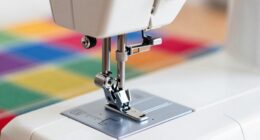
To master double-needle sewing, start by choosing the right twin needle size and type for your fabric, like ballpoint for knits and sharp for woven fabrics. Test on scraps to adjust tension and stitch length. Use pins or clips to keep your fabric aligned, sew slowly for control, and stabilize delicate or stretchy fabrics with tissue paper or interfacing. Keep practicing with these tips to perfect your technique and achieve professional-looking hems—more secrets await if you keep going.
Key Takeaways
- Always test on scrap fabric first to adjust tension and stitch length for optimal results.
- Match the twin needle size to your fabric’s weight and stretchability for smooth sewing.
- Use pins or clips to keep fabric layers aligned and prevent puckering or skipped stitches.
- Sew slowly and steadily to maintain control and achieve even, professional-looking stitches.
- Choose the correct needle type (ballpoint for knits, sharp for woven fabrics) for best fabric compatibility.

If you want to elevate your sewing projects, mastering twin needle tricks is essential. One of the most important skills to develop is understanding hemming techniques with a double needle. When you use a twin needle, you create professional-looking hems that are durable and flexible, perfect for knit fabrics, jersey, and lightweight woven materials. The key is to choose the right twin needle size and type for your fabric, ensuring fabric compatibility and preventing puckering or skipped stitches. For instance, a 2.5mm or 3.0mm twin needle works well for lightweight fabrics, while heavier fabrics like denim or canvas require a wider spacing, such as 4.0mm or 6.0mm. Always check the fabric’s weight and stretchability to determine the best match.
Using the correct hemming techniques with a twin needle can considerably improve your finished projects. Before sewing, set your machine to a straight stitch and adjust the tension if needed. Many machines have a twin needle setting, but if yours doesn’t, you can manually set the tension to prevent skipped stitches. It’s helpful to test on scrap fabric first. When hemming, fold your fabric twice to hide raw edges, then sew with the twin needle along the folded edge. This method produces a clean finish with two parallel rows of stitches on the right side and a secure, stretchable seam on the inside. To keep the hem even, use pins or clips to hold the folded edge in place, and sew slowly to maintain control.
Another important aspect is understanding fabric compatibility. Not all fabrics respond well to twin needle sewing. Lightweight or stretchy fabrics tend to work best because they can stretch without puckering. Heavy or thick fabrics might require a wider twin needle or a different technique altogether. If a fabric is prone to puckering, you can try stabilizing it with tissue paper or interfacing during sewing, then tear away or trim the stabilizer afterward. Using the right needle size and type also helps; ballpoint twin needles are ideal for knits, while sharp twin needles suit woven fabrics.
Frequently Asked Questions
Can All Sewing Machines Accommodate a Twin Needle?
Not all sewing machines can accommodate a twin needle, so you should check your machine’s compatibility first. Most machines with a standard twin or zigzag stitch setting can handle different needle sizes, but it’s important to verify your machine’s specifications. Look at the needle clamp and user manual to make sure it can fit the twin needle you choose. Using the right needle sizes guarantees smooth sewing and prevents damage.
What Types of Fabrics Are Best Suited for Twin Needle Sewing?
Imagine your fabric transforming into a runway star with twin needle sewing! You’ll find stretch denim and lightweight knits are perfect choices. Stretch denim allows for flexible, durable seams, while lightweight knits glide smoothly under the needle, creating beautiful, professional-looking stitches. These fabrics handle double-needle work beautifully, giving your projects a polished finish. So, pick these fabrics for flawless double-needle sewing magic every time!
How Do I Troubleshoot Skipped Stitches With a Twin Needle?
To troubleshoot skipped stitches with a twin needle, first check your thread tension; it should be balanced to avoid uneven stitches. Next, confirm your needles are aligned properly in the needle holders and securely inserted. Also, use the correct needle size and type for your fabric. If issues persist, test on scrap fabric, adjusting tension and needle position until stitches are even and smooth.
Does Using a Twin Needle Affect Machine Maintenance or Needle Life?
Ever wondered if using a twin needle impacts your machine’s maintenance or needle wear? It does, but only slightly. Make sure your machine is compatible with twin needles to prevent unnecessary strain. Using a twin needle can cause minor needle wear faster than a single one, so regular checks and timely replacements are essential. Proper setup and maintenance keep your machine running smoothly and extend needle life, making double-needle sewing a breeze.
Are There Specific Thread Types Recommended for Twin Needle Projects?
For your twin needle projects, you should choose dual thread options that are compatible with your machine and fabric. Polyester or cotton threads work well, but opt for high-quality threads to prevent breakage. Use color matching techniques to blend threads seamlessly or create contrast for decorative effects. Always match thread types and weights to your fabric to guarantee smooth sewing and durable stitches.
Conclusion
Mastering twin needle techniques can elevate your sewing projects with professional-looking finishes. Did you know that using a twin needle can save you up to 30% of the time compared to traditional hemming methods? With practice, you’ll effortlessly create beautiful, even stitches on knit and woven fabrics. So keep experimenting and refining your skills—soon, double-needle sewing will become second nature, giving your creations that polished, high-quality touch every time.