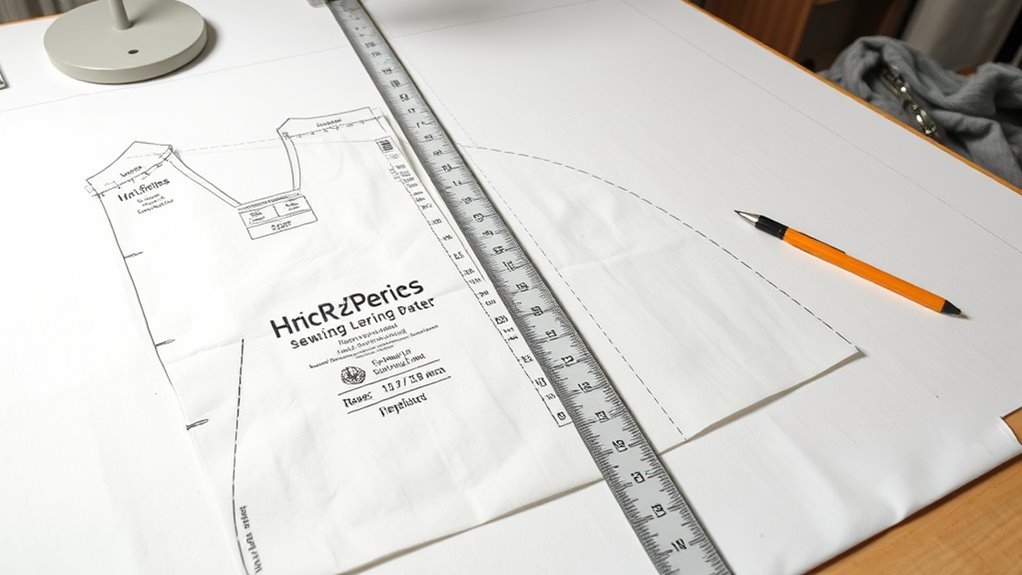

To adjust your sewing pattern for height, start by locating the lengthen/shorten line on the pattern, usually marked between pattern pieces. To make it longer, cut along the line and spread the pattern apart, adding paper beneath to maintain the shape. To shorten, overlap the pieces slightly. Be sure to make symmetrical adjustments and test with a muslin first. If you keep going, you’ll pick up some helpful tips for perfecting your fit.
Key Takeaways
- Use the pattern’s lengthen/shorten lines to add or remove length uniformly across the pattern.
- To lengthen, cut along the line, spread apart, and insert additional paper; to shorten, overlap and tape the pattern.
- Make adjustments gradually to preserve pattern proportions and avoid distortion.
- Always test fit with a muslin before cutting your final fabric.
- Verify measurements against your height and proportions to ensure a perfect, comfortable fit.
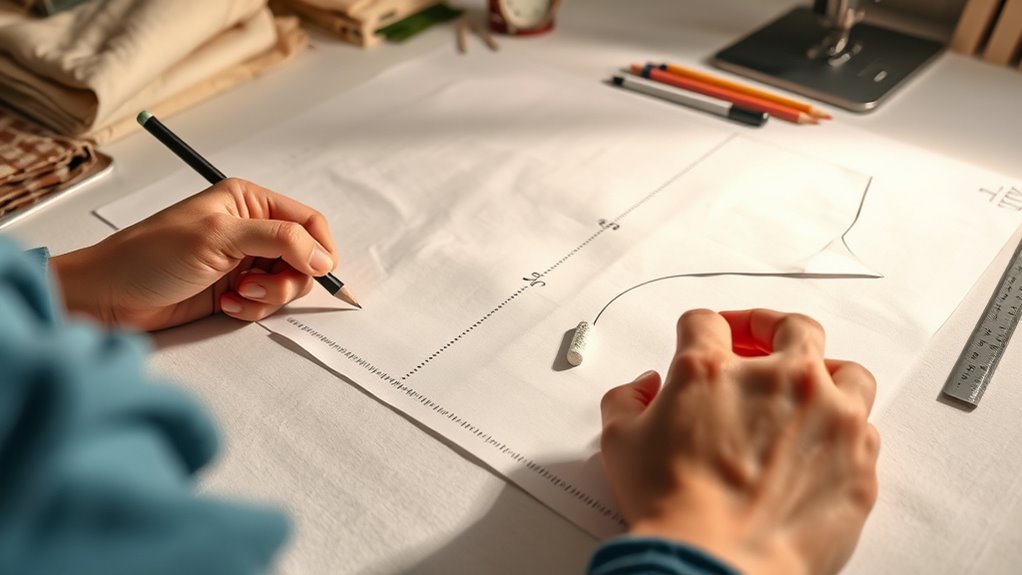
Have you ever struggled to get a sewing pattern to fit perfectly because of your height? If so, you’re not alone. Many sewists find that commercial patterns often need adjustments to suit their proportions, especially when it comes to length. The good news is that lengthening or shortening a sewing pattern is straightforward once you understand some key techniques. Whether you need to customize sleeve length or modify crotch depth, these adjustments can make a significant difference in achieving a comfortable, flattering fit.
Adjusting pattern length ensures a perfect fit for your height and proportions.
When working on sleeve length, the goal is to match the pattern’s sleeve to your arm length. To customize sleeve length, measure from your shoulder seam to your wrist, then compare that to the pattern’s sleeve length. If the pattern’s sleeve is too long, you’ll want to trim from the bottom, but do so gradually, maintaining the shape of the sleeve cap. If it’s too short, you can add fabric by inserting a rectangular extension between the existing sleeve and the cuff or cap. Remember to add seam allowances to ensure your adjustments blend seamlessly. This approach ensures your sleeves don’t end at an awkward point and that your garment feels comfortable throughout.
Modifying crotch depth is another common adjustment for taller individuals. To get this right, measure from the waistline to the point where your crotch naturally sits. Compare this measurement to the pattern’s crotch depth. If the pattern sits too high, you’ll need to add length to the crotch area; if it’s too low, remove some length. To lengthen, cut along the inseam from the crotch to the hem and spread the pattern apart, adding paper underneath to maintain the original shape. For shortening, overlap the pattern pieces slightly. Be cautious to preserve the pattern’s shape and grainline, as improper adjustments can lead to uncomfortable fits or distortion. Additionally, contrast ratio considerations can help in visualizing how the fit will look, especially in the darker or shadowed areas of the garment.
Adjusting for height isn’t limited to sleeves and crotch; you can also lengthen or shorten the entire pattern by adding or removing length from the pattern’s lengthen/shorten lines, typically found on the pattern pieces. Remember to do all modifications symmetrically and to make a muslin or test garment first. This step helps you verify the fit before cutting into your final fabric, saving you time and material. With patience and practice, customizing sleeve length and modifying crotch depth become second nature, empowering you to craft garments that fit perfectly, regardless of your height.
Frequently Asked Questions
Can I Adjust Pattern Length Without Altering Fit?
Yes, you can adjust pattern length without changing the fit. To do this, carefully add or remove length at the designated adjustment lines, ensuring you maintain proper pattern alignment to avoid fabric distortion. Use a ruler or pattern notcher to keep everything straight. This way, you preserve the original fit while customizing the length, and your sewing results will look neat and professional.
How Do I Modify Patterns for Very Petite or Tall Figures?
To modify patterns for very petite or tall figures, start with petite adjustments or tall figure tailoring. For petites, take up the pattern at the waist or hemline, and adjust the armholes and neckline accordingly. For tall figures, lengthen the pattern at the designated lengthen lines, usually at the torso or legs. Always make muslins first to guarantee a proper fit before cutting your final fabric.
What Tools Are Best for Lengthening or Shortening Patterns?
You’ll want to grab a good pattern ruler and fabric scissors for lengthening or shortening patterns. The pattern ruler helps you draw clean, precise lines to alter the pattern’s length, while fabric scissors ensure you cut accurately without damaging your fabric. Using these tools, you can easily adjust the pattern’s length, making sure it fits your height perfectly. With a little practice, your sewing projects will turn out just right!
Is It Necessary to Alter Seam Allowances When Adjusting Length?
You don’t need to modify the seam allowances when adjusting the pattern length unless you plan to add or remove fabric at the seams. The pattern alteration impact is mainly on the pattern’s length lines, so seam allowances stay the same unless specified. If you change the pattern’s length at the seams, you might need to adjust the seam allowances slightly to ensure proper fit and seam construction.
How Do Pattern Adjustments Affect Fabric Grain and Pattern Matching?
When you adjust your pattern, it can affect fabric grain and pattern matching. To maintain proper grain alignment, make sure you realign grain lines after lengthening or shortening. For pattern symmetry, carefully match pattern pieces at seams, especially if you’ve made significant adjustments. This helps keep designs like stripes or plaids aligned correctly. Always double-check grain directions and pattern matching to ensure your finished garment looks professional and well-constructed.
Conclusion
By mastering the art of adjusting your sewing pattern for height, you become the architect of your own style, shaping garments that fit like a finely tailored suit. Think of your pattern as a blank canvas—stretching or shrinking it allows your personal silhouette to emerge in perfect harmony. With a few thoughtful tweaks, you can turn any pattern into a bespoke masterpiece, ensuring your wardrobe flows seamlessly as an extension of your unique stature and spirit.