TL;DR

Get business pricing on tools and workshop supplies
- Business-only prices and quantity discounts
- Tax-exempt purchasing
- Multiple users, one account, clear invoices
Hunker describes a DIY bird feeder made from a glass jar, wooden spoon, wire and jute. The spoon serves as a perch near the jar opening, while the jar holds seed; the feeder needs regular cleaning and careful placement near windows.
Hunker has detailed a DIY bird feeder made from a glass food jar or Mason jar, a wooden spoon, wire and jute, offering a way to reuse household materials while putting bird seed in an accessible spot. The spoon is attached along the jar as a perch, and a wire-and-jute hanger lets the finished feeder hang sideways from a hook.
The project uses a glass jar and wooden spoon, plus garden wire, bendable aluminum wire, jute, two decorative wooden beads, glue, scissors, paint brushes and paint suitable for glass. Bird seed is added after assembly. Hunker attributes the design to Anna King of makinghomematters, whose version uses the spoon bowl as a place for birds to perch and feed beside the jar opening.
In the instructions, the spoon is glued lengthwise to the jar, with its bowl extending from the open end. Garden wire wrapped around the jar helps hold the spoon in place; jute is attached over the wire as decoration. Once the paint has dried, the maker adds aluminum wire and wooden beads to form a handle. The feeder is then hung sideways from a hook.
Hunker says the feeder should be cleaned regularly, particularly in colder months when more birds may visit. Its placement advice is to put it either within about three feet of a window or at least 30 feet away, and to keep native plants and, if possible, nearby trees around the site for cover. These are recommendations in the source article, not results from a reported test of the design.
A Reuse Project With Upkeep
The design offers a practical use for a jar that might otherwise be discarded and can fit in a small outdoor space. Its central idea is straightforward: the jar stores seed, while the spoon provides a landing and feeding surface. The wire and hanger make it possible to suspend the assembly from a suitable hook.
However, a homemade feeder is not maintenance-free. Hunker stresses that users should clean it regularly, with more frequent attention during busy feeding periods. That maintenance matters because seed and surfaces exposed to weather and visiting birds need to be checked, rather than treated as a set-and-forget garden decoration. The article does not provide a cleaning schedule or sanitation procedure.
The project also puts responsibility on the maker to consider where the feeder hangs. Hunker gives specific window-distance guidance and recommends nearby natural cover. Readers should treat those details as the source’s advice and account for local conditions, including the feeder’s stability, weather exposure and whether birds can approach it safely.
Popular right now

Shark Rocket Ultra-Light Corded Stick Vacuum, HV301, Gray/Orange

KitchenAid Artisan 5-Quart Tilt-Head Stand Mixer, KSM150PS, Almond Cream

De'Longhi Rivelia Automatic Espresso Machine with Milk Frother
As an affiliate, we earn on qualifying purchases.
How the Jar Feeder Works
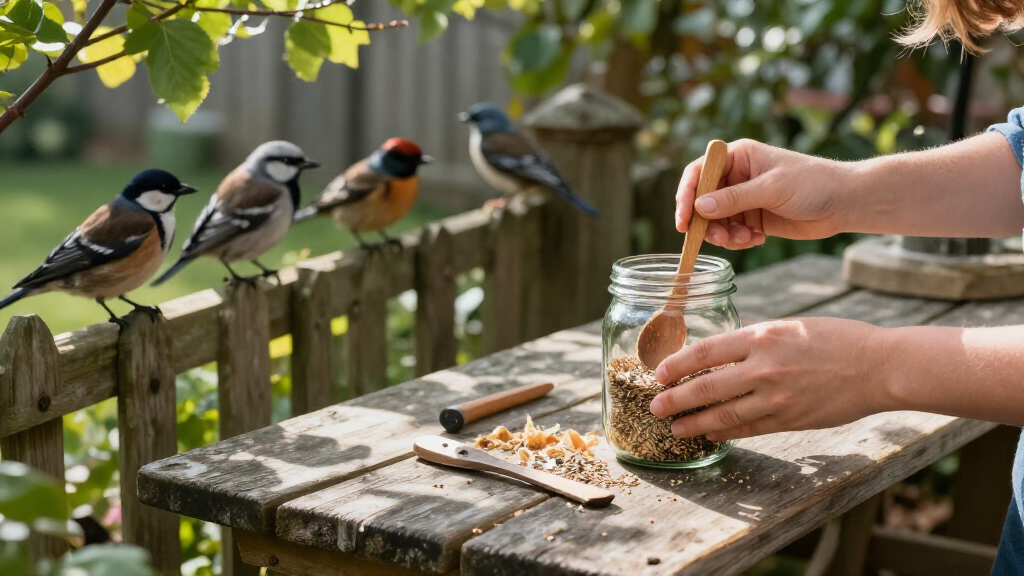
Hunker’s report presents the feeder as a repurposing craft project rather than a commercially tested product. It describes a Mason jar or other glass food jar, with the spoon secured to its side so the bowl projects at the opening. The feeder hangs horizontally, allowing seed to remain in the jar while birds use the spoon as a perch.
The article also suggests painting the jar with glass-suitable paint and decorating the hanger with jute and beads. Those finishes are optional design choices; the functional parts described are the seed container, spoon perch and hanger. The source says the project can use materials already on hand, but does not give a price estimate, assembly time or measurements for the jar and spoon.
“Attach a wooden spoon and hanger to create a bird feeder.”
— Hunker, describing the project
Details the Instructions Leave Open
The source does not specify jar dimensions, spoon size, wire gauge or how much seed the feeder holds. It also does not report whether the design was tested for long-term outdoor use, how well the glue and decorations withstand rain, or how securely the jar stays in place in wind. Those factors may vary with materials and assembly.
Hunker does not provide a step-by-step cleaning method or explain how often to replace seed in different weather conditions. The article’s placement recommendations are stated, but it does not cite research or identify the source of those measurements. Readers should not assume the suggested paint color will reliably attract birds: the report offers color as a design consideration but provides no supporting evidence for that claim.
Before Hanging the Finished Feeder
Anyone following the project will need to assemble the jar, spoon and wire hanger, allow any paint to dry, then add seed and choose a stable location. Hunker’s next practical steps are to check the window distance, look for nearby plants or trees and make a plan for regular cleaning. The article does not announce a later update or a scheduled follow-up; the next developments depend on how an individual builds and maintains the feeder.
Before use, makers should check that the spoon and hanger are secure and that the glass is not cracked. The source offers no tested load limits or weatherproofing guidance, so the feeder should be inspected after hanging and during use. Any uncertainty about a safe placement or mounting point should be resolved before the feeder is left outdoors.
Key Questions
What materials does the jar bird feeder use?
Hunker lists a glass jar, wooden spoon, garden wire, bendable aluminum wire, jute and two wooden beads, along with glue, scissors, paint brushes, glass-suitable paint and bird seed.
How does the wooden spoon fit onto the jar?
The spoon is attached lengthwise to the jar, with its bowl extending from the open end. The bowl acts as a perch beside the feeding opening, while garden wire helps hold the spoon in place.
Where does Hunker recommend hanging the feeder?
The article advises placing it either about three feet from a window or at least 30 feet away. It also recommends nearby native plants and, if possible, trees that can provide cover.
Does the feeder need regular cleaning?
Yes. Hunker says to clean the feeder regularly, especially during colder periods when more birds may visit. The report does not set a specific cleaning interval or describe a cleaning method.
Source: hunker.com