
TL;DR

Get business pricing on tools and workshop supplies
- Business-only prices and quantity discounts
- Tax-exempt purchasing
- Multiple users, one account, clear invoices
A Hunker report describes reusing old glass jars as decorative storage by wrapping them in jute twine attached with hot glue. The project can hide labels and logos, but it is a home craft idea, not a newly announced product or independently tested storage solution.
Hunker has published a do-it-yourself guide for turning used glass jars into rustic storage containers by wrapping their exteriors in jute twine and securing it with hot glue. The approach can cover old labels and branded surfaces while reusing jars for pantry, countertop or other household storage, though the report does not provide independent testing of the finished containers.
The guide recommends starting with clean, dry jars. Remove labels slowly, then soak the glass in soapy water to loosen leftover adhesive before scrubbing. To address lingering odors, Hunker suggests filling a jar with an equal mixture of vinegar and water and leaving it overnight. The jar should be fully dry before twine or glue is applied.
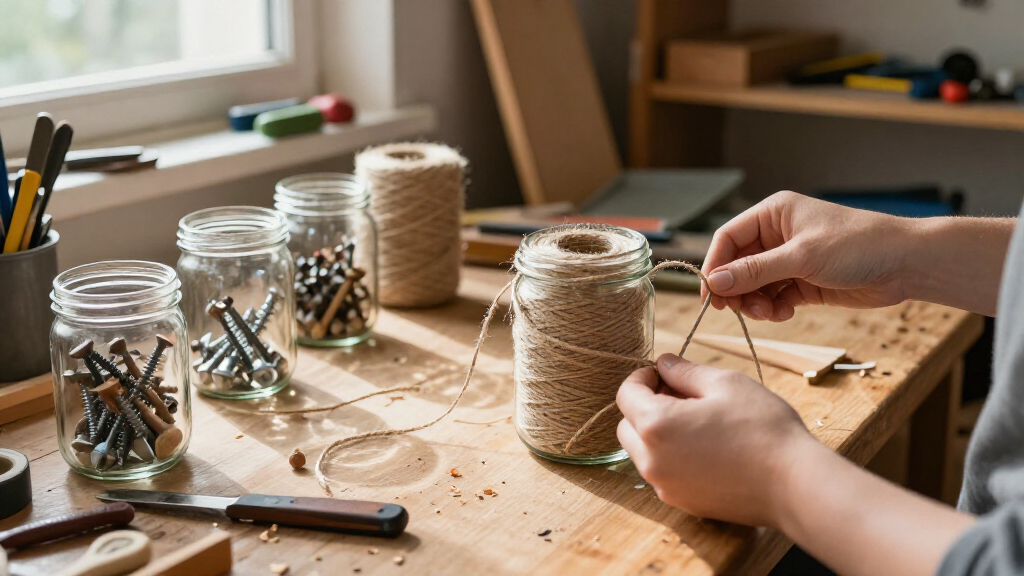
For the wrap, attach the end of the twine to the center of the jar’s base with hot glue, then work outward in a spiral. Once the twine reaches the base’s edges, continue upward around the sides. The report also describes starting a separate length just below the lid and wrapping the lid itself, while warning that too much glue around the jar’s threads may make it harder to open.
The design can cover the whole jar or leave sections of glass exposed. Hunker suggests leaving a gap between the wrap at the bottom and the wrap higher on the jar to make room for an embellishment, such as twine spirals attached to burlap or narrow strips arranged as stripes. The finished jars could be used on open shelves or as storage in different rooms; the report also proposes placing a battery-powered tea light inside as a centerpiece.
A Low-Cost Use for Empty Jars
The idea offers a way to reuse glass containers that might otherwise be discarded and make them more suitable for display. For households seeking inexpensive storage, the materials named in the guide are simple: an existing jar, jute twine and hot glue, with scrap burlap as an optional addition. Covering labels and logos may also help make a collection of mismatched jars look more coordinated.
The visual result is the main benefit described, rather than a change in how the jar functions. Twine partially hides the glass and can create a basket-like appearance, but a full wrap also makes it harder to see the contents. Readers choosing jars for pantry organization may want to leave an uncovered area or otherwise mark what is stored inside. The source does not claim that the craft improves preservation, makes a jar safer for food, or makes it suitable for every storage use.
Popular right now

Ninja Hot & Iced XL Coffee Maker with Rapid Cold Brew, Black, CM371

Sony BRAVIA 5 85-Inch Mini LED 4K HDR Smart TV (K-85XR50)

Roborock F25 GT Set Cordless Wet Dry Vacuum Cleaner and Mop with 2 Brushes
As an affiliate, we earn on qualifying purchases.
From Label Removal to Twine Wrap
The supplied Hunker report presents this as a household craft project, not as a product launch, formal research finding or new safety standard. Its central problem is cosmetic: reused jars can retain labels, glue or branded lids that make them look less polished when placed on counters or open shelves. The twine is proposed as a covering that gives the containers a more rustic appearance.
The instructions proceed in two stages: prepare the glass, then attach the decorative material. Cleaning and drying come before gluing, while the wrap can begin either at the base or near the lid depending on the chosen design. Hunker describes options for full coverage, partial coverage and added burlap decoration, leaving the pattern to the maker.
““some glass jars aren’t exactly aesthetically pleasing””
— Hunker report
Limits of the Craft Instructions
The supplied report does not specify a publication date, test the durability of the twine or glue, or state how the jars hold up to moisture, frequent handling or cleaning. It also does not identify a particular glue product or give safety instructions for using a hot-glue gun. Readers should follow the tool maker’s safety directions and keep hot glue away from skin.
The guide does not establish that decorated jars are suitable for food contact or for use with heat or open flames. It specifically suggests a battery-powered tea light, not a real candle. Whether a covered jar is appropriate for a particular item depends on the materials and use; the source provides no testing or claims on those questions.
Choose a Pattern and Use
The next step for anyone following the guide is to select a clean, fully dry jar and decide whether to cover it completely or leave parts of the glass visible. Makers can then apply the twine with hot glue, taking care around the lid threads, and add optional burlap details after the main wrap is in place.
Hunker’s report does not announce a follow-up test or additional development. The outcome will depend on the jar, the pattern and the quality of the application; questions about long-term durability and cleaning remain unanswered by the supplied material.
Key Questions
What supplies does the Hunker guide recommend?
It names jute twine and hot glue, along with an old glass jar. Scrap burlap is optional for decorative details.
How should a jar be prepared before wrapping?
Remove the label, soak the jar in soapy water to loosen adhesive, scrub it clean and let it dry completely. The report suggests an equal mixture of vinegar and water left overnight to address odors.
Where should the twine wrapping begin?
For a base-up wrap, attach the twine at the center of the jar’s bottom and spiral outward before continuing up the sides. The report also describes starting a separate length below the lid.
Can the finished jars be used as candle holders?
The report suggests using a battery-powered tea light as a centerpiece. It does not recommend an open flame or provide evidence that a twine-covered jar is safe with a real candle.
Source: hunker.com