TL;DR

Get business pricing on tools and workshop supplies
- Business-only prices and quantity discounts
- Tax-exempt purchasing
- Multiple users, one account, clear invoices
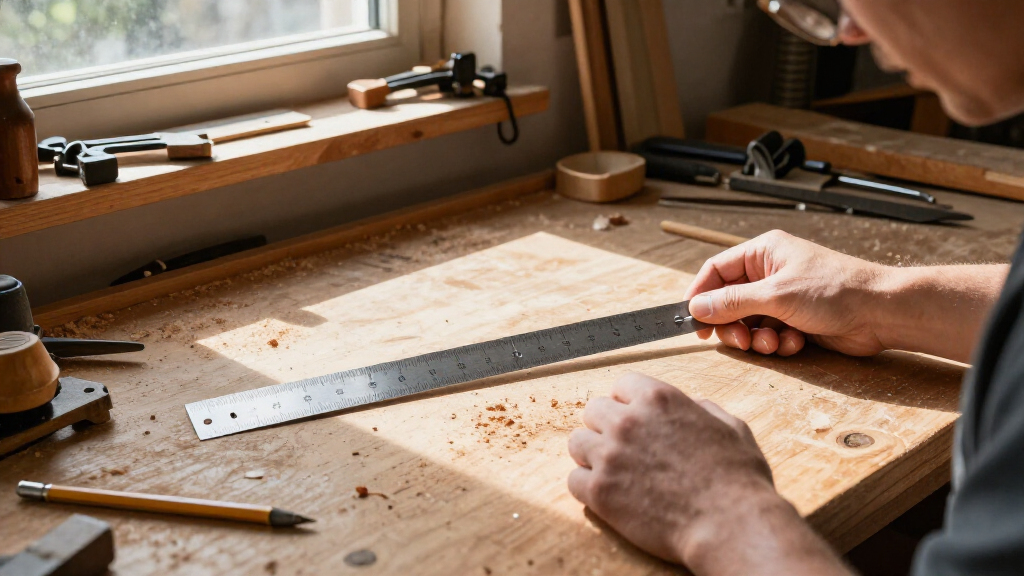
The hole near the end of many rulers is mainly a hanging point, making the ruler easier to store on a hook or peg. A Family Handyman report also describes an older classroom use involving slate boards, while holes on some specialty rulers serve different functions.
A hole near the end of many rulers is there mainly to make the ruler easier to hang and store, according to a Family Handyman report. The feature can also have other uses: some school rulers fit into binders, while certain craft and specialty rulers use openings to help with drawing or marking.
The most common purpose is storage. A ruler can be hung from a hook, nail or pegboard rather than left in a drawer or on a work surface. That can be especially useful for long metal rulers that may not fit conveniently in a toolbox. The hole does not affect a ruler’s ability to measure: the report says a ruler without one can measure just as accurately.
The article also recounts a historical classroom use. Before paper notebooks became common in schools, students wrote on reusable slate boards, wiping them clean with a damp cloth. Some students reportedly tied the cloth to a ruler using its hole, keeping it close at hand. The source cites the University of Wisconsin–Madison’s object history of slate, but does not provide a date for when this practice began or how widespread it was.
Other openings are designed for specific tasks, not simply hanging. Some school rulers have three binder holes spaced to fit a standard three-ring binder. On certain specialty rulers, a pin can hold the ruler at a pivot point while a pencil in another opening traces a circle. Crafting and quilting tools may have openings or slots for marking fabric, aligning material or guiding a rotary cutter. Their function depends on the ruler’s design.
A Small Feature With Practical Uses
For most people, the hole is a simple storage feature, not a hidden measuring function. Recognizing that can help explain why a ruler is shaped the way it is and offer a straightforward way to keep a longer ruler accessible instead of misplaced in a crowded drawer.
The distinction matters when choosing a tool. A standard ruler’s end hole does not make measurements more accurate, while openings on a specialty craft ruler may support particular marking or cutting tasks. Those functions should not be assumed for every ruler: manufacturers make different designs for different uses, and the article cautions that a compass remains a better choice when exact circle measurements matter.
Popular right now

Shark HydroVac MessMaster Wet/Dry Vacuum & Mop Combo (AW261)

KitchenAid 5.5-Qt Bowl-Lift Stand Mixer, Porcelain White (KSM55SXXX)

Ninja CM401 Specialty Coffee Maker with 10-Cup Carafe and Fold-Away Frother
As an affiliate, we earn on qualifying purchases.
From Slate Boards to Storage Hooks
The hole’s reported classroom history is tied to a time when students used reusable slate boards rather than paper notebooks for writing practice. A cloth used to wipe the slate could be attached to a ruler, according to the Family Handyman account. The source presents this as an earlier use, but does not establish that it was the original reason all rulers were made with holes.
Modern examples reflect the variety of rulers available. The source references products and information from STAEDTLER, Kapro and Westcott, as well as the University of Wisconsin–Madison. It describes rulers ranging from small plastic school tools to longer metal versions and specialized quilting or paper-craft tools. The number and placement of holes vary with the manufacturer’s intended use.
“The hole at the end of a ruler is mainly there for storage.”
— Family Handyman report
What the Hole’s History Establishes
The source describes the slate-wiping-cloth practice as a past use, but it does not give a date, identify a specific school system or show how commonly students used rulers this way. It also does not establish whether that historical use led manufacturers to add holes in the first place. The current explanation is more limited: many end holes serve for hanging, while some other holes support specific tasks.
There is no single function for every ruler opening. Without details about a particular model, it is not possible to say whether a hole is intended for hanging, binder storage, drawing, craft marking or more than one purpose.
Check the Ruler’s Intended Use
No new product announcement or follow-up development is reported. For readers looking at a particular ruler, the practical next step is to check its packaging or the manufacturer’s product information for its intended uses. A plain end hole can generally be used to hang the ruler, while openings on a specialty tool may have specific instructions.
For ordinary measuring, the presence or absence of a hole does not change the ruler’s stated measurement markings. Anyone using openings to draw circles or guide a craft task should follow the tool’s directions and use a compass or other purpose-made tool when precise measurements are needed.
Key Questions
What is the hole at the end of a ruler for?
It is mainly for hanging and storage, such as on a hook, nail or pegboard.
Did the hole have an older classroom use?
According to the Family Handyman report, some students used the hole to tie a cleaning cloth to a ruler when they wrote on reusable slate boards. The source does not say how common or widespread the practice was.
Can holes in a ruler help draw circles?
Some specialty rulers have openings that can act as pivot or pencil points for drawing circles. Not every ruler is designed for this, and the report says a compass is a better choice when exact measurements matter.
Do the holes affect measurement accuracy?
No. The report says a ruler without holes can measure just as accurately as one with them, assuming its markings are suitable and readable.
Why do some rulers have several holes?
The openings may be intended for different tasks. Some school rulers fit into a three-ring binder, while craft and quilting rulers may use openings or slots to mark, align or guide cutting.
Source: familyhandyman.com